

2026 Ascend at the Aspen Institute Forum on Children and Families
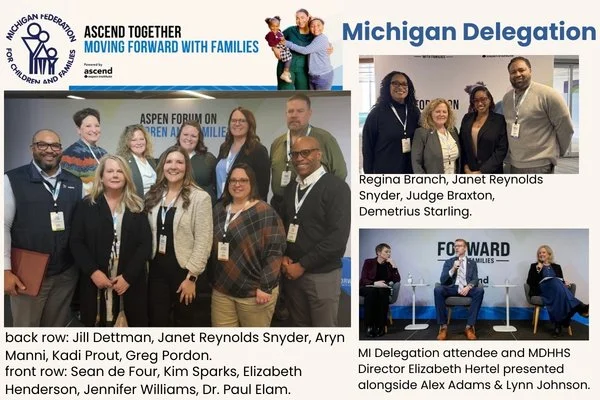
The Michigan Federation for Children and Families partnered with The Kresge Foundation to support a group of family preservation, behavioral health, and child welfare leaders to attend the 2026 Ascend at the Aspen Institute Forum on Children and Families in Washington, DC, on January 27-28, 2026. This is Ascend’s single biggest public program and gathering, delving into how leaders from across the country can take action to move the needle on socioeconomic mobility for families and implement 2Gen strategies in their work. Over the course of two days, 220 invited participants gathered in Washington, DC, and another 1,000 parents, policymakers, practitioners, and researchers convened virtually to share new innovations, lessons learned, and practical strategies for what it takes to build and sustain well-being for all children and families.
Michigan Department of Health and Human Services Director Elizabeth Hertel was a featured presenter on a panel with Alex Adams, Assistant Secretary for Family Support with the Administration for Children and Families at the U.S. Department of Health and Human Services. Director Hertel and Asst. Secretary Adams spoke to how federal and state agencies come together to translate vision into action for families, noting what is working well to advance positive outcomes in our communities across the country.
The Michigan individuals identified for this opportunity are directly involved in implementing or will be partners in expanding the MiFamily Together pilot. This opportunity to expand knowledge of the 2Gen framework, engage in meaningful learning experiences, and build vital connections with other organizations across the country is a true example of a public-private partnership. The virtual audience had the opportunity to learn more from Janet Reynolds Snyder, President/CEO of the Michigan Federation for Children and Families, and Demetrius Starling, Program Officer for Human Services at The Kresge Foundation. Ms. Reynolds Snyder and Mr. Starling spoke about how Michigan is one of the leaders in the nation advancing a 2Gen framework into our family preservation service array and how this is being applied in practice to promote real change within communities.
On the Ground and in Motion: How States Are Advancing Family Well-Being
Senior leaders from both federal and state agencies come together to examine how they are translating vision into action for families. Panelists will share what’s actually happening on the ground: what’s working, what’s hard, and how they are navigating constraints to advance affordability, economic mobility, and family well-being. The session offers a candid look at implementation, innovation, and leadership at the state and local level -- and what others can learn from these efforts.
PANELISTS:
Alex Adams, Administration for Children and Families
Elizabeth Hertel, Michigan Department of Health and Human Services
Lynn Johnson, All In Empowering Futures
Produced in partnership with Ascend at the Aspen Institute on the Forward with Families campaign. This video features the MiFamily Together program, The Kresge Foundation Managing Director of Human Services Dr. Raquel Hatter, Michigan Federation for Children and Families President/CEO Janet Reynolds Snyder, MDHHS Director Elizabeth Hertel, and Steelcase Foundation President Daniel Williams. A special thanks to Federation member agencies Samaritas and Vista Maria for providing footage featured in this film.

A Task Force was established by the Michigan Department of Health and Human Services (MDHHS) Director in Fall 2020 to address the overrepresentation of children of color in the MDHHS Children’s Services Administration (CSA). Children of color enter foster care at higher rates, and stay in care longer, than their white peers.
PRESS RELEASE | Child Welfare Task Force Cites Progress, Announces New Focus
Multi-generational strategy
The task force’s new 2Gen work group will help the state develop a two-generation or multi-generational approach to child welfare that recognizes the interconnection of the needs of children with parents and other caregivers. The work group will be led by Janet Reynolds Snyder, president/ceo of the Michigan Federation of Children and Families and a member of the task force.
Snyder said 2Gen gives “attention to the needs of both the child and the caregiver for the child as a whole picture, a whole family. It is about bringing the voices of those families as experts into the design and implementation of what services are most helpful for their families, promoting increased family wellbeing and prosperity of each family member.”
For the past year, the Federation has partnered with MDHHS, a Lived Experience Advisory Council and representatives from community-based organizations who work directly with families in launching MiFamily Together pilots in 25 counties. MiFamily Together reduces the number of different family preservation programs families need to navigate and integrates services to children with those for caregivers. It recognizes that children do better when their parents or other caregivers are doing better.
In MiFamily Together’s first year, nearly 1,000 families were enrolled for services. Of those enrollments, 95% of children remained safely at home as of October 2025, Snyder said. She said Michigan’s 2Gen work is drawing attention across the country. The task force work will assist MDHHS in expanding MiFamily Together statewide in 2026.
“I am proud of the committee’s work, and everyone’s excited about the direction we’re going, and the two-generation approach,” said Wayne County Circuit Judge Karen Braxton, who chairs the task force. “I’m excited about the impact that we can have not just in Michigan, but also becoming national leaders.”

-
Check out this one-page summary of early Mi Family Together (MFT) program outcomes, as of May 2026.
-
MiFamily Together Flow Chart created by Wellspring Lutheran Services
-
MiFamily Together Infographic, by Samaritas, Bethany Christian Services and Orchards Children’s Services
-
MiFamily Together state map, and list of counties/providers.
-
MiFamily Together Pilot
The Michigan Department of Health and Human Services (MDHHS) and its community-based partners are pleased to announce the launch of the MiFamily Together (MFT) program. The two-year pilot program started in October 2024 in 25 counties throughout the state with four Federation member agencies piloting a new contract and program. The goal of services is to deliver more flexible family preservation programming that is responsive to each family’s needs whether they are in crisis, need some extra support to avoid out-of-home placement, or they have children returning home from foster care.
The MiFamily Together pilot is designed to streamline access to services and create efficiencies by concentrating resources, integrating best practices, and reducing the number of different programs families must navigate as their needs evolve. This approach should increase positive outcomes as families will no longer have to build rapport with different workers in new provider agencies as their service needs change. The pilot integrates a two-generation, or 2Gen, whole-family approach to have a more comprehensive and holistic approach to working with both the children and the caregivers in the home. Although the main focus of service delivery will be to reduce the risk of child maltreatment, 2Gen recognizes the importance of addressing the needs of the whole family unit while increasing well-being and prosperity. This means elements like adult/child education, mental and physical health, supporting job skill development, community engagement, and building a social support network will also be integrated into service delivery.
THE 2GEN APPROACH
-

What is 2Gen?
Two-generation (2Gen) approaches build family well- being by intentionally and simultaneously working with children and the adults in their lives together. As children, parents, and families grow and change across their lifespan, 2Gen approaches align opportunities to help families pursue their goals and thrive, optimizing each person’s potential along the way. The results are healthy parents with family-supporting jobs, healthy children meeting developmental milestones, and better-connected individuals able to participate in civic and family life.
-

2Gen Guiding Principles
There are countless essential experiences and opportunities that are required for people to reach their full potential. To facilitate connections to these supports, all 2Gen policies and programs are grounded in and guided by 5 core principles.
-

Partners
The 2Gen approach moves away from siloed thinking and towards innovative practice and policy. Collaboration across agencies and sectors, data sharing, and leveraging existing resources to drive down costs and to promote economic success for the whole family is at the heart.
CLICK HERE to view the 2Gen Core Workgroup Agency Partners
-

2Gen Collaborative Toolkit
Across the country, communities are increasingly recognizing the need for integrated approaches that support the well-being of both children and the adults in their lives. To build on this momentum, Ascend at the Aspen Institute is proud to release the 2Gen Collaborative Toolkit, a companion resource to The 2Gen Investment Case report.
This Toolkit is designed for mid-level and senior leaders in nonprofit, philanthropic, and public organizations seeking to strengthen a regional or place-based 2Gen approach. It provides tangible guidance for executing 2Gen strategies and mobilizing community-led solutions to improve outcomes for whole families.
Each section includes practical considerations, guiding questions, and sample tools to support community implementation.
Sabihi, S. (2025). The 2Gen Collaborative Toolkit: A Practical Guide for Advancing Place-Based 2Gen Strategies. Washington, DC: Ascend at the Aspen Institute.
LEARN MORE
-

2Gen Learning Resources
The 2Gen Toolbox was produced by a partnership between Ascend at the Aspen Institute and the Aspen Institute Community Strategies Group (CSG), and supported by the W.K. Kellogg Foundation and the Annie E. Casey Foundation. The inclusion of more than 300 resources in the toolbox reflects input from key 2Gen leaders and consultants, gathered by Karen Murrell (Higher Heights Consulting), Aspen CSG and Ascend.
-

2Gen Videos
-

Michigan Title IV-E Prevention Plan
Michigan Department of Health and Human Services (MDHHS) in collaboration with youth and parents with lived experience, community organizations, legal and judicial partners, service providers, tribal partners, and other public human-service agencies, have embraced a bold vision for a 21st century children’s services system oriented around prevention of abuse or neglect, family well-being and race equity.

The Michigan Federation for Children and Families would like to thank the Aspen Institute for making so many resources available to advance 2Gen practice throughout the world.
The Kresge Foundation has been an instrumental partner in moving this body of work forward in Michigan.